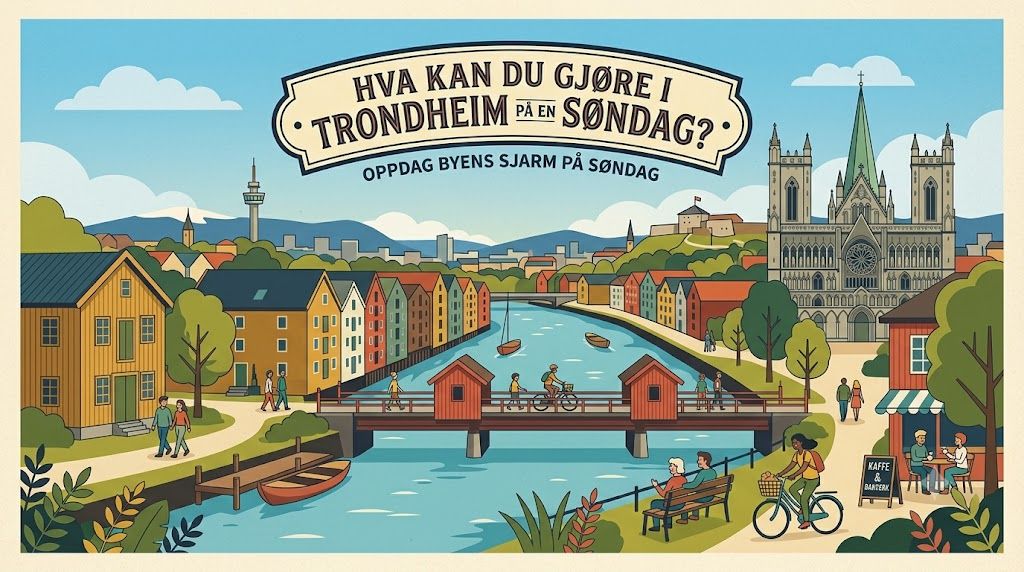
Ask a visitor what they associate with Sundays in Norway, and the answer is usually the same: closed shops, empty streets, a city that's gone back to sleep. That's not entirely wrong — Norway does have a law requiring shops to stay closed on Sundays. But that doesn't mean Trondheim is closed. It means Trondheim on a Sunday looks completely different from Trondheim on a Saturday, and if you know where to go, it's one of the best days of the week to explore the city.
This applies just as much to you if you live in Trondheim and need an excuse to get off the sofa, as to a visitor wondering why the centre suddenly feels quieter than the day before. Norwegians themselves call Sunday "annerledesdagen" — "the different day" — a day with its own rhythm, where the pace is deliberately slowed down. That's not a sign that nothing is happening, but a reminder that what's on offer on a Sunday is different from the rest of the week, and that you get the most out of the day if you plan accordingly.
This guide covers why Sunday works differently in Norway, and which places in Trondheim are built exactly for that day — the cathedral, the fortress, the museums, the island out in the fjord, and the hiking trails waiting for you while the shops stay shut.
Why Sunday is different in Norway
To understand why some things are open and others aren't, it helps to know a little about the rules. The Holiday Peace Act (Helligdagsfredloven) of 1995 states that retail outlets must, as a general rule, stay closed on Sundays. That's why the shopping centre and most clothing shops have their doors shut when you walk past.
But the law has a number of exceptions, and it's precisely these exceptions that define a good Sunday in Trondheim. Serveringssteder — restaurants, cafes and bars — are exempt from the law and can stay open as normal. The same goes for grocery stores and kiosks under 100 square metres, flower shops, and places defined as "typical tourist locations." Museums, sights and attractions fall outside the law entirely, since they aren't engaged in ordinary retail sales.
In practice, this means: the cafe is open, the museum is open, the cathedral is open — but the big supermarket and the Vinmonopolet (state alcohol monopoly) are closed. If you want to bring drinks along on a Sunday outing, you'll need to shop on Saturday, or plan around a venue with a serving licence instead. It's one of the things that surprises the most visitors, and a good reason why Sunday in Norway suits experiences better than shopping.
There's actually a nickname for the small-grocery-store exception: "Brustad-bu," named after former Minister of Trade Sylvia Brustad, who at the time opened the door for kiosks and grocery stores under 100 square metres to stay open on Sundays. If you see a small corner shop with its doors open on a Sunday in central Trondheim, this is the rule that makes it possible — useful to know if you just need milk or an emergency bar of chocolate before the rest of the day's plans.
It's also worth mentioning that the rules are enforced somewhat differently from municipality to municipality, and that the county governor can grant exemptions for special occasions like festivals, anniversaries or major sporting events. If you find something open that you didn't expect, or closed when you thought it should be exempt, it's usually a local exemption like this — or the lack of one — behind it.
Start the day at Nidaros Cathedral
It's hard to talk about Trondheim without starting at Nidaros Cathedral (Nidarosdomen). The cathedral is built over the grave of Olav the Holy — the Viking king who Christianised Norway and fell at the Battle of Stiklestad in 1030. Construction began around 1150 and continued for over a hundred years, and the cathedral has been a pilgrimage site for nearly a thousand years since. Since 1906, Nidaros Cathedral has been Norway's coronation church, used for the blessing of regents.
Services are held throughout the day on Sundays, and everyone is welcome to attend regardless of faith. Visiting hours vary by season — in summer the cathedral is normally open to visitors on Sundays from early afternoon, while the winter half of the year has shorter opening hours. Always check the cathedral's own website for current times before you go, since both services and opening hours are adjusted through the year.
Right next door is the Archbishop's Palace (Erkebispegården), one of the oldest preserved secular buildings in the Nordic region, with roots back to the Middle Ages. Here you can see Norway's crown jewels — the crown, the sceptre and the orb — in a dedicated exhibition, along with a small mint workshop said to be the world's northernmost. The combination of cathedral and archbishop's palace probably gives you the densest concentration of Norwegian history you'll find in one place in the country.
Take time to study the west front before you go in. The facade carries 76 statues and a series of reliefs arranged in three rows — the apostles at the bottom, Norwegian saints in the middle, prophets and kings from the Old Testament at the top — gathered around a rose window eight metres in diameter. What you see today isn't medieval, though: only five statues survived the decay of the centuries, and the restoration of the west front ran from the early 1900s all the way to 1983. Nidaros Cathedral's restoration workshop (known as "Bygghytta") was established as early as 1869 and is still working continuously on the cathedral, over 150 years later — one of the longest-running restoration projects in Europe. The cathedral is also the formal endpoint of the pilgrim route from Oslo to Trondheim, a route that has drawn pilgrims to Olav the Holy's grave for close to a thousand years, and which has seen a clear revival in recent decades.
Kristiansten Fortress: views and gravity
A short walk east of the centre, up the hill above Bakklandet, sits Kristiansten Fortress. It was built between 1681 and 1685, after a major city fire reduced large parts of Trondheim to ashes in April 1681. King Christian V ordered a new city and fortification plan, resulting in both a new street grid in the centre and a tower fortress on the high ground to the east.
The fortress got its big test in 1718, when Swedish general Armfeldt laid siege to Trondheim with an army of several thousand men. The city held, largely thanks to Kristiansten's presence, and the Swedish campaign ended in disaster on the retreat over the mountains. The fortress was decommissioned as a military installation in 1816, but got a new life as the city's fire watch — and during the Second World War it was used by the German occupying forces as an execution site for Norwegian resistance fighters. A memorial chapel at the execution site still stands on the grounds, a quiet and solemn spot in the middle of what is otherwise one of the city's most-used recreational parks.
Today the fortress grounds are free to visit and open year-round, with some of the city's best viewpoints over Trondheim, the fjord and the surrounding mountains. Around 135,000 people visit the fortress annually, and it's easy to see why once you're standing at the ramparts with the whole city spread out below. From the viewpoints, if you know what to look for, you can also make out the "shoreline" (strandlinja) — an old coastal edge in the terrain around Byåsen that shows where sea level sat after the last ice age, long before the land rose to its present form. Bring a picnic if the sun cooperates — that's exactly what the spot is built for.
Bakklandet and a Sunday brunch
Back down from the fortress, on the east side of the Nidelva river, lies Bakklandet — Trondheim's first suburb, originally home to craftsmen, small traders and working people. The low, colourful wooden houses that make the neighbourhood one of the most photographed in the city were originally simple homes and storage wharves, not the picturesque cafes and shops you find there today. The area is often split in two: Øvre Bakklandet south of the Old Town Bridge, and Nedre Bakklandet to the north of it, with slightly different character but the same cobblestones and timber facades throughout.
This is also where the Holiday Peace Act's exemption for serveringssteder really comes into its own. While the shops further into the centre have closed, the cafes on Bakklandet are in full swing with Sunday brunch. The combination of old timber buildings, the Nidelva flowing past, and a city on Sunday time makes this one of the best places to spend a morning before the rest of the day's plans.
The old town bridge connecting Bakklandet with the centre is a sight in itself — known locally as "Lykkens portal" (the Portal of Luck), after a tradition that you should walk through it to secure good fortune. Whether you believe it or not, it's a nice reminder to look up from your phone while crossing the river. From the bridge you also get one of the most photographed views in all of Trondheim, with the colourful wharf facades on both sides of the river.
Sverresborg Trøndelag Folk Museum: open every single weekend
If you're only picking one museum in Trondheim for a Sunday, Sverresborg makes the choice easy: it's actually open every weekend, all year round, unlike many other cultural institutions that close outside the high season. The museum is considered the country's third-largest cultural-history open-air museum, with over 80 buildings spread across a large outdoor area.
The museum is built around the ruins of Sverresborg — Norway's oldest medieval castle, built by King Sverre in the 1180s. Today the museum grounds are divided into three sections: the Town, the Village and the Castle. In the town section you wander through rebuilt Trondheim houses from the 1700s and 1800s, including Nattmannshuset — the home of the city's most despised inhabitant in the 1700s, the man responsible for handling waste and executions. In the village section you'll find farmsteads from across Trøndelag gathered in one place, with the medieval Haltdalen stave church as the clear highlight of the collection. A replica of the traditional Detli house from Oppdal, also found here, has incidentally been copied for Disney World in Florida — an odd little detail that says something about how architecturally interesting the Trøndelag building tradition actually is.
The walk up to the castle ruins themselves at the top of the museum grounds gives a fine view over Trondheim, and a reminder that the city has been a centre of power long before Nidaros Cathedral and Kristiansten came along. In 1938, incidentally, a skeleton was found in the castle's old well — something that wasn't fully investigated until archaeological excavations in 2014 and 2016. The remains can today be seen at NTNU's Science Museum, if you want to follow the story further after your visit to Sverresborg.
Opening hours follow the season: in the high season (from around 21 June to mid-September) the museum is open every day, while the rest of the year it's open Thursday to Friday during the day and Saturday–Sunday from morning to afternoon. In the low season there's often a dedicated Sunday programme with guided walks and activities for children, typically around 11am–3pm. Check current times before you go, since they're adjusted somewhat from year to year, and since children get in free regardless of season, this is one of the most affordable Sunday destinations on the list.
Munkholmen: the island with the darkest history in the fjord
If it's summer as you're reading this, Munkholmen belongs on the list. The small island sits just a couple of kilometres out in the Trondheimsfjord, and the boat runs from Ravnkloa in the centre roughly every hour throughout the summer season — from May to September, depending on weather and demand. In May, departures run between 10am and 4pm, expanding to 10am–6pm in June, July and August. Return trips leave at quarter past every hour, and the ticket is valid all day, not tied to a specific departure — useful if you don't want to plan your Sunday down to the minute. Ticket prices start at around 65 kroner for adults.
Munkholmen's history is surprisingly grim for a place mostly associated today with swimming and picnics. In the Viking age, the island was Trondheim's execution site — this is said to be where Olav Tryggvason mounted the heads of his defeated enemies, Earl Håkon and his servant Kark, on stakes as a warning. In the 1000s the island instead became home to Nidarholm Abbey, likely Norway's oldest, where Benedictine monks built up an economic empire based on farming, shipping, trade — and brewing. After the Reformation, the abbey ruins were used as a quarry for a new fortress, which was expanded in the 1600s. During the Second World War, the German occupying forces placed anti-aircraft guns on the island to protect the U-boat base in Trondheim.
Today the grim history is most visible through tours of the fortress tower, casemates and dungeon. The rest of the island is a relaxed summer idyll: large grassy lawns for picnics and sunbathing, a swimming beach, and a cafe that serves, among other things, a well-known homemade fish soup with a view back toward the city. A good Sunday plan is to spend the morning at Nidaros Cathedral and Bakklandet, and use the afternoon on Munkholmen while the sun is still high — the boat trip alone, under the low bridge by the harbour and out onto open water, is worth the price of the ticket.
Note: the island is only accessible in the summer season. The rest of the year you'll have to settle for the view from land, but Sverresborg and Ringve are there as good year-round alternatives instead.
Bymarka: the forest that's Trondheim's shared garden
West of the city lies Bymarka, an enormous forest and outdoor recreation area that functions as Trondheim's answer to a shared backyard. In summer it's a network of hiking trails and swimming spots that makes Bymarka a natural destination for a quiet Sunday outing, while winter turns the same area into one of Norway's most-used ski terrain, with floodlit tracks and groomed trails right from the edge of the city. This is part of why Trondheim is regularly ranked among Norway's best cities to live in for outdoor enthusiasts — very few of the country's larger cities have a continuous "marka" area this close to the centre.
What makes Bymarka especially practical is how close it sits to the city itself — several of the access points are within walking distance or a short bus ride from the centre, and Gråkallbanen (the city's old tram line) quickly takes you up to the starting point for several of the most popular routes. Whatever the season, this is where Trondheim residents themselves head on a Sunday when they want fresh air without leaving the city. Bring a packed lunch, since neither cafes nor kiosks are a given once you're inside the marka.
If you want something calmer and closer to the city, the coastal path Ladestien follows the fjord from areas near the centre and northward — a nice walk if you want fresh air and water views without heading all the way out into the marka.
Ringve Music Museum and the botanical garden
A little outside the centre, in Lade north of the city, lies Ringve Music Museum — Norway's national museum for music and musical instruments, with a collection of over 2,000 instruments from around the world. The museum is housed in an old manor surrounded by the Ringve Botanical Garden, and is one of the few cultural institutions in Trondheim that consistently stays open on Sundays (11am–4pm, closed only on Mondays). Guided tours of the main building, where guides play historical instruments, are the museum's signature offering, and in summer this is supplemented with daily mini-concerts.
The botanical garden itself is worth the trip alone. 130 acres of freely accessible grounds, open every day, all year round, with no entrance fee — established by the NTNU Science Museum in 1973. Here you can walk the nature trail, look at the duck pond, or just find a quiet grassy corner to sit in. The combination of museum and garden makes Ringve one of the most relaxed Sunday destinations in Trondheim, and a good alternative to the centre if you want some distance from the crowds at Nidaros Cathedral.
Frequently asked questions about Sundays in Trondheim
Is everything closed in Trondheim on Sundays?
No. Shops are generally closed, but restaurants, cafes, museums, sights and smaller grocery stores under 100 square metres are exempt from the law and can stay open as normal.
Can I buy beer or wine on a Sunday in Trondheim?
The Vinmonopolet is always closed on Sundays, in every city. If you want to bring drinks home, you'll need to shop on Saturday. If you want to drink out, restaurants and bars with a serving licence are unaffected by the Sunday rule and stay open as usual.
What is "Brustad-bua"?
A popular nickname for the exemption in the law that lets kiosks and grocery stores under 100 square metres stay open on Sundays, named after former Minister of Trade Sylvia Brustad.
Is Munkholmen open all year?
No, the boat to Munkholmen only runs in the summer season, normally from May to September. The rest of the year the island isn't accessible to regular visitors.
Which museum is the safest bet to find open on a Sunday?
Sverresborg Trøndelag Folk Museum and Ringve Music Museum both stay open on Sundays year-round, unlike several other cultural institutions that have reduced hours outside the summer season.
Do I need a car to get around on a Sunday outing in Trondheim?
No. Everything mentioned in this guide — Nidaros Cathedral, Bakklandet, Kristiansten, Munkholmen and Sverresborg — is either within walking distance of the centre or covered by public transport. Ringve requires a bus or a longer walk, but isn't car-dependent either.
A practical Sunday route in Trondheim
If you want to put this into practice, here's a simple route that captures much of the best the city has to offer across one Sunday:
- Morning (10:00–12:00): Nidaros Cathedral and the Archbishop's Palace — start with the cathedral while the morning calm still hangs over the centre, and take in the crown jewels at the Archbishop's Palace right next door.
- Early afternoon (12:00–14:00): Bakklandet — cross the Old Town Bridge and find yourself a Sunday brunch among the colourful timber houses, with a short detour up to Kristiansten Fortress for the view if you're up for the hill.
- Late afternoon (14:00–17:00): Munkholmen (summer) or Sverresborg (year-round) — if it's summer season, take the boat from Ravnkloa and spend the rest of the day on the island. Outside the season, head to Sverresborg instead, which stays open on Sundays year-round regardless.
- Evening: a venue with a serving licence — since the Vinmonopolet and the big grocery stores are closed, a bar or restaurant with a serving licence is the practical (and legal) option if you want to end the evening with a drink.
The whole route is doable on foot and by public transport, and you can get through it without having to rush between stops — which is itself pretty fitting for a Sunday.
The bottom line
Trondheim on a Sunday isn't a city that's closed — it's a city that's shifted its focus. The shops take the day off, but the cathedral, the fortress, the museums and the cafes with a serving licence do exactly what they're built to do: stay open when the rest of the city takes it easy. Once you know the difference between what's closed and what's exempt from the law, Sunday quickly becomes the best day of the week to discover Trondheim.
It's also, when you think about it, a fairly fitting summary of the city as a whole: Trondheim has never been the place shouting loudest for attention. The history sits in the cathedral walls and the fortress ramparts rather than in neon signs, and a Sunday — when the pace is slower anyway — is really the day of the week best suited to discovering that side of the city.
Opening hours for sights and museums change with the season. Always check current times with the individual venue before you plan your Sunday.